2026 Mortgage Renewal in Canada: When to Start, How to Compare Lenders, and Mistakes to Avoid

General Jeannie Mongrain 1 Apr

If your mortgage is coming up for renewal this year, this is not the time to leave it until the last minute.

A lot of homeowners in Canada are heading into renewal after years of major changes in rates, home values, and monthly costs. That does not automatically mean your renewal will be a problem. But it does mean your old mortgage may not be the best fit anymore.

That is why a 2026 Mortgage Renewal in Canada is such an important topic right now.

The good news is this: renewal is one of the few times you get a real chance to step back, review your options, and make sure your mortgage still works for your life today, not just for the version of your life from a few years ago.

Why a 2026 Mortgage Renewal in Canada matters more than usual

A 2026 Mortgage Renewal in Canada matters because so many borrowers are renewing in a very different environment than the one they started in.

Some people locked in when rates were much lower. Others now have different income, different debts, different goals, or new plans for their property. On top of that, many people are unsure whether they should simply sign their lender’s offer, switch mortgage lenders, or look at renewal vs refinance instead.

That uncertainty is normal.

What matters is not guessing.
What matters is starting early enough to make a smart decision.

The Financial Consumer Agency of Canada also notes that you can negotiate with your current lender and compare outside offers before renewing, which is exactly why leaving yourself enough time matters.

When to start planning a 2026 Mortgage Renewal in Canada

If you ask me, the best time to start planning a 2026 Mortgage Renewal in Canada is earlier than most people think.

A lot of homeowners wait until the lender sends a renewal letter and then assume that is when the process really starts. That is usually too late if you want options.

A better approach is to start reviewing your situation at least 90 to 120 days before maturity, especially if you may want to compare lenders, change terms, or adjust your mortgage strategy. Many lenders allow rate holds well before your actual renewal date, and the Bank of Canada’s 2026 schedule also gives borrowers clear dates to watch if they are paying close attention to rate decisions.

At a minimum, you do not want to leave yourself with less than about 45 days if there is any chance you may be changing lenders.

That extra time can help you:

  • review your current lender’s offer
  • compare mortgage renewal offers
  • collect updated documents
  • deal with any surprises
  • avoid making a rushed decision

Mortgage Renewal Tips: do not assume the first offer is the best one

One of the most important mortgage renewal tips I can give you is this:

Do not assume the first offer from your lender is the best offer you can get.

It might be decent.
It might even be competitive.

But it also might not be the right fit for your goals.

Your lender is usually focused on keeping your mortgage in-house. That is different from making sure you have explored all available options.

Mortgage renewal tips are not just about chasing the lowest rate, either. They are about looking at the whole picture, including:

Interest rate

Of course the rate matters. Every time you renew your mortgage term, you renegotiate your mortgage interest rate, and that can raise or lower your payments.

Term length

A shorter or longer term may make more sense depending on what you think you will do next. The FCAC notes that term and amortization choices affect your overall costs and payment amounts.

Prepayment privileges

If you want the flexibility to pay your mortgage down faster, this matters more than many people realize.

Penalties

Some mortgages look great on the surface, but become very expensive if you need to break them early later on.

Flexibility

Can you make changes later if your plans shift? That question matters a lot more than people think.

If you are comparing mortgage renewal offers, you want to compare all of those pieces, not just the headline rate.

Compare mortgage renewal offers before you sign anything

One of the biggest mistakes people make is signing the renewal offer because it feels easy.

Easy is not always wrong.
But easy is not always best.

If you want to compare mortgage renewal offers properly, ask questions like:

  • Is this rate actually competitive right now?
  • Is the term length right for my next few years?
  • How flexible is this mortgage if life changes?
  • What would it cost to break this mortgage early?
  • Would another lender give me a better overall structure?

This is where a broker can be especially useful.

Instead of looking at just one lender’s offer, you can compare mortgage renewal offers across multiple options and look at what actually fits your needs best.

The FCAC’s renewal guidance specifically encourages borrowers to negotiate and use competing offers to push for a better deal. Here is a helpful government resource on renewing your mortgage.

Renewal vs refinance: know the difference before you decide

This is where a lot of homeowners get tripped up.

Renewal vs refinance is not the same conversation.

A renewal usually means you are replacing your current mortgage term with a new one, often with the same balance and without changing much else.

A refinance means you are making bigger changes to the mortgage itself.

That could include things like:

  • increasing the mortgage amount
  • consolidating debt
  • accessing equity
  • adding a HELOC
  • changing the amortization

Understanding renewal vs refinance matters because some people go into renewal already knowing they want to make changes, but they still sign the basic renewal first. Then later they find out they need to break that new mortgage and pay a penalty just to do what they wanted to do in the first place.

If you think you may want to restructure anything, do not treat it like a basic renewal.

That is a renewal vs refinance conversation, and it should happen before you sign anything.

Switch mortgage lenders if the better option is elsewhere

A lot of people assume they have to stay with their current lender forever.

They do not.

If a better option is available, you may be able to switch mortgage lenders at renewal with little or no penalty, depending on the timing and the structure of the new mortgage.

This is one of the strongest opportunities for a 2026 Mortgage Renewal in Canada.

If your current lender gives you an offer that is just okay, that does not mean you have to accept it. Sometimes switching lenders gives you a better rate. Sometimes it gives you better flexibility. Sometimes it gives you a better long-term fit.

The main thing to remember is this:

If you want to switch mortgage lenders, start early.

Changing lenders can involve:

  • updated income documents
  • a credit check
  • property information
  • legal and administrative timing
  • lender turnaround time

None of that is impossible.
It just gets much harder when you leave it too late.

Mortgage renewal mistakes to avoid in 2026

If I had to narrow it down, these are some of the biggest mortgage renewal mistakes I see homeowners make:

1. Leaving it until the last minute

This is probably the biggest one.

When you leave renewal too late, you lose leverage, lose time, and often lose options.

2. Focusing only on rate

Rate matters, but it is not the whole mortgage.

A slightly lower rate with more restrictions or worse penalties is not always the better deal.

3. Not reviewing whether your life changed

If your income changed, debts changed, goals changed, or you may want to buy another property, your renewal strategy may need to change too.

4. Signing a simple renewal when you really need a refinance

This is a very common and expensive mistake.

If you want to consolidate debt, pull equity, or restructure the mortgage, treat it as a bigger planning conversation upfront.

5. Assuming your lender will automatically give you the best option

Sometimes they will not. That is why comparing matters.

Mortgage Renewal Process Canada: a simple checklist

If you want the Mortgage Renewal Process Canada to feel less overwhelming, here is a simple checklist.

90 to 120 days out

  • review your maturity date
  • think about whether your goals changed
  • decide whether you may want to switch mortgage lenders
  • ask about current rates and rate hold options

45 to 60 days out

  • compare mortgage renewal offers
  • gather updated income and property documents if needed
  • review renewal vs refinance if you want changes
  • ask questions about penalties, prepayment privileges, and flexibility

Before you sign

  • make sure the payment is comfortable
  • make sure the term makes sense
  • make sure the mortgage fits your next few years, not just today
  • make sure you are not rushing into a decision because time ran out

Final thoughts on a 2026 Mortgage Renewal in Canada

A 2026 mortgage renewal in Canada does not have to be stressful.

But it does deserve your attention.

If your renewal is coming up this year, do not assume the easiest path is automatically the best one. Start early. Compare your options. Think about whether you need a straight renewal or something bigger. And make sure the mortgage you move into still matches your life today.

That is how you give yourself more control.

And in a market where so many people feel uncertain, more control is a very good place to start.

If your renewal is coming up and you want help reviewing your options, reach out before the last-minute rush. Even a quick conversation can help you avoid mistakes and make a more confident decision.

Spring 2026 Home Buying Plan in Canada: Pre-Approval, Offer Conditions, and RRSP Down Payment Tips

General Jeannie Mongrain 3 Mar

If you’re thinking about buying a home this spring, the biggest advantage you can give yourself is not “timing the market.”

It’s having a plan before you fall in love with a house.

Spring is when listings increase, buyers get more active, and decisions start to feel faster. The buyers who feel calm through the process usually do three things early:

  1. They get a real pre-approval

  2. They understand how the financing condition actually works

  3. They build a down payment strategy (including RRSP options if it fits)

This Spring 2026 home buying plan will walk you through those steps in plain language.

Step 1: Get a Mortgage Pre-Approval Checklist Ready (Not a Quick Calculator)

A true mortgage pre-approval is not a website estimate.

It’s a full review of your income, credit, and down payment so you know what you can realistically afford before you start shopping.

What lenders typically need for pre-approval

Your mortgage pre-approval checklist usually includes:

  • Recent pay stubs

  • Letter of employment

  • Proof of down payment (bank statements or investment statements)

  • Government-issued ID

  • Additional income documents if applicable (bonus, commission, child tax benefit, rental income, etc.)

The “30-day rule” buyers don’t expect

A common friction point in the mortgage approval process is document recency. Many lenders want documents to be current, and employment letters and pay stubs are often expected to be recent (commonly within 30 days).

So if you’re pre-approved today but don’t submit an offer for a few weeks, you may need refreshed documents at offer time. That’s normal. It’s not starting over. It’s the lender verifying the file properly.

Step 2: Financing Condition on Offer: Why You Still Need It

Even if you’re pre-approved, a financing condition on offer is still one of the smartest protections you can include.

Why? Because a mortgage is usually two approvals:

  • You (income, credit, down payment)

  • The property (the home itself)

The home is a major part of the equation. Lenders need to review what you’re buying, not just who you are.

What happens after your offer is accepted

Here’s the typical flow once an offer is accepted:

  1. Updated docs (if needed)
    If documents on file are older, you’ll usually need updated pay stubs, an employment letter, and updated down payment statements.

  2. Submission to the lender
    I structure the file and submit it to the lender for review.

  3. Lender review timeline
    How long does mortgage approval take? Sometimes it can be quick, but it can also take 48 hours or longer depending on lender volume and time of year.

  4. Appraisal (sometimes required)
    If the lender requires an appraisal, it gets ordered and we wait for the results.

“Approval” does not always mean you can remove the condition

This is the part that creates stress.

Even if you receive an approval document, you still need the lender to fully sign off on:

  • income

  • down payment

  • property details

  • any remaining conditions (including appraisal, if required)

Only when the lender confirms everything is satisfied can you safely remove the financing condition.

This is also why timelines matter. If your offer has a financing condition, make sure the timeframe is realistic. Short conditions can create unnecessary pressure and lead to extensions.

Step 3: Down Payment Canada: Use the Tools Available (Including RRSP Home Buyers’ Plan)

If you have the down payment saved, spring can be a strong time to explore buying.

Not because you have to rush.

Because being ready gives you options.

RRSP Home Buyers’ Plan (HBP): the key basics

The RRSP Home Buyers’ Plan allows eligible buyers to withdraw funds from their RRSP toward a home purchase, up to $60,000 per person.

You also have up to 15 years to repay the amount you withdrew.

This can be a powerful tool when used properly, especially for buyers who have money in RRSPs but want to keep more cash accessible during the purchase.

Important note: HBP rules have eligibility details and timing requirements, so it’s worth planning this before offer day, not after.

The real goal with down payment strategy

Down payment strategy is not just “how much can I put down?”

It’s also:

  • how much cash you should keep in reserve

  • what payment is comfortable

  • what closing costs look like

  • how to structure the mortgage so you’re not house-poor

Step 4: Your Spring 2026 Home Buying Plan Checklist (Do This This Week)

If you want this to feel simpler, here’s a clean checklist to start with:

  1. Pick your target timeline
    Are you buying in 30 days, 90 days, or later this year?

  2. Get pre-approved properly
    Have your mortgage pre-approval checklist ready, not just a rate quote.

  3. Confirm your down payment plan
    Savings, RRSP HBP, gifts, investments, and what you’re keeping as a buffer.

  4. Plan your offer strategy
    Including a financing condition on offer and a realistic timeline.

  5. Run the numbers for your comfort, not just approval
    Approval amount and comfortable payment are not always the same.

Final Thoughts

Spring buying can be exciting, but it moves faster when you’re unprepared.

If you want a calm, clear plan for Spring 2026, start with the three foundations:
pre-approval, financing condition awareness, and down payment strategy.

If you want, I can send you a simple checklist for:

  • what documents to gather

  • what to refresh at offer time

  • how to think about RRSP HBP properly

Reach out anytime if you’d like a copy of my checklists

Mortgage Renewals in 2026

General Jeannie Mongrain 1 Feb

Mortgage Renewal in 2026: How to Avoid Payment Shock and Protect Your Cash Flow

If you’re heading into a mortgage renewal in 2026, you’re probably hearing a lot of noise.

Payments are higher. Rates might go down. Rates might go up. Prices might dip more. Maybe they bounce.

But the thing most homeowners are actually worried about is simpler:

“What happens to my monthly payment when I renew?”

You’re not alone, and it’s not as bad as people think, as long as you don’t leave it to the last minute.

Why So Many Canadians Are Feeling Pressure

There’s a big wave of renewals happening right now.

The Bank of Canada has flagged that about 60% of mortgage holders are expected to see a payment increase.

They’ve also noted that about 60% of outstanding mortgages will renew before the end of 2026.

That doesn’t mean everyone is in trouble.

But it does mean a lot of people are going to be renewing at a higher rate than what they locked in years ago, especially anyone who secured a mortgage in 2021–2022.

And at the same time, the housing market has been soft in many areas. For example, WOWA’s January 20, 2026 update shows Canada’s benchmark price at $660,300, down 4.0% year-over-year.

That combination (higher renewals + softer values) is why planning matters.

Mortgage Renewal Options: What You Can Do If Your Payment Is Jumping

A mortgage renewal isn’t just paperwork. It’s one of the few times you can make meaningful changes without overcomplicating your life.

Here are the most common mortgage renewal options that can help protect cash flow:

1) Shop the renewal instead of signing the first offer

Many lenders will send a renewal letter that feels like it’s the default option.

It isn’t.

Shopping your renewal can mean:

  • a better rate
  • better terms
  • more flexibility
  • or a mortgage structure that fits your real budget

2) Choose the right term for your life, not the headlines

A lot of people try to “guess” where rates are going.

But timing the market is almost impossible.

A better strategy is to pick a term based on:

  • how stable you want your payment to be
  • how long you plan to keep the home
  • whether you might refinance, move, or upgrade in the next 1–3 years

3) Adjust the mortgage structure to fit your budget

Your financial life has probably changed since you got your current mortgage.

Renewal time is when you can look at things like:

  • amortization remaining
  • payment frequency
  • whether your mortgage has good prepayment options
  • penalty risk if you need flexibility later

How Much Will My Mortgage Payment Increase at Renewal in 2026?

This is the question everyone asks.

The honest answer is: it depends on your balance, rate, remaining amortization, and term.

But to set expectations, the Bank of Canada estimates that compared with December 2024 payments, the average monthly mortgage payment could be about 6% higher for those renewing in 2026.

That’s an average. Some people will see a small change. Others will feel a much bigger jump.

You might have seen “$700 per month” used as an example online. That number can be real in certain scenarios. For instance, IG Wealth shared an example where moving from a low pandemic-era rate to around 4.75% resulted in an increase of almost $700 per month.

The key point is not the exact number.

The key point is this: you want to know your range early, before your renewal becomes urgent.

Refinance at Renewal: The “Reset” Option Most Homeowners Don’t Consider

If your payment increase is going to stretch you month to month, this is where a lot of people get stuck:

They assume refinancing means an even bigger payment, because rates are higher now than 4–5 years ago.

But that’s not always true, because most households are not dealing with just a mortgage payment.

They’re dealing with:

  • credit cards
  • lines of credit
  • car loans
  • other monthly debt payments

Why refinancing can LOWER your monthly outflow

When you refinance at renewal to consolidate higher-interest debt into the mortgage, your mortgage payment might rise slightly, but your total monthly payments often drop.

Example (simple math):

  • If you are paying $1,200–$2,000 per month across multiple debts
  • And refinancing increases your mortgage payment by a few hundred dollars
  • You can come out ahead with more cash flow and fewer payments to manage

This is not about pretending debt disappears.

It’s about lowering the cost of carrying it and making your budget manageable again.

The big misconception that keeps people stuck

A lot of clients reach out for a refinance, then panic and renew instead because:

  • they feel ashamed about the debt
  • they think refinancing means “starting over”
  • they assume higher rates automatically mean higher payments

In reality, consolidating high-interest debt can be the thing that stops the spiral.

Why Timing Matters: Home Values Affect Your Refinance Options

One more important piece:

If home values continue to soften in your area, your available equity can shrink, which can reduce refinancing options.

WOWA’s national data shows the benchmark price down year-over-year.

That doesn’t mean you should panic. It means you should be proactive.

If refinancing might help your cash flow, it’s worth exploring sooner rather than later, while you have more flexibility.

Fixed vs Variable in 2026: A Simple Way to Decide Without Stress

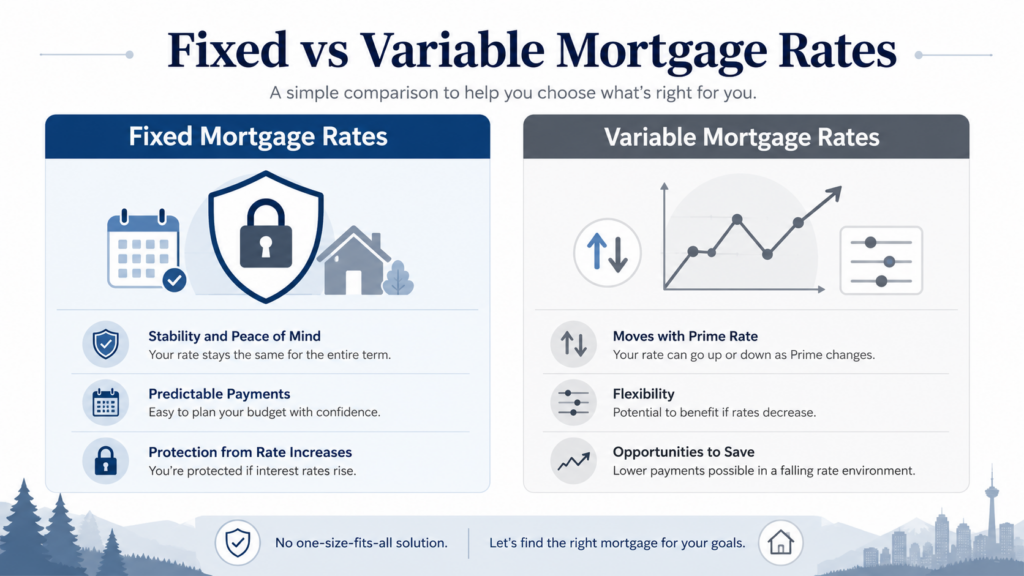
People love to ask: “Should I go fixed or variable?”

A better question is: What do you need most over the next 1–5 years?

If you value stability

Fixed can make sense when you want:

  • predictable payments
  • predictable budgeting
  • less mental load

If you value flexibility

Variable (or shorter terms) can make sense when you want:

  • the ability to pivot
  • a plan to refinance or move
  • different risk tolerance

There’s no universal right answer.

There’s only what fits your cash flow and your plan.

Mortgage Renewal Checklist: What to Do 3–6 Months Before Renewal

If you take nothing else from this blog, take this.

The biggest mistake is waiting until the renewal letter hits your inbox and you feel rushed.

Here’s a simple mortgage renewal checklist:

1) Find your renewal date

If you don’t know it, you can’t plan.

2) Get a current mortgage statement

Balance, rate, term, amortization remaining.

3) Identify the real pressure points

Is it the mortgage payment, or is it debt plus mortgage plus life?

4) Run a few scenarios

  • Straight renewal
  • Switching lenders
  • Refinance at renewal (if debt is part of the issue)
  • Different terms (1–5 years)

5) Decide based on your life, not predictions

You’re allowed to prioritize cash flow.

Most people would rather not struggle month to month than save a little interest on paper while feeling stressed every payday.

Final Thoughts on Mortgage Renewal in 2026

A mortgage renewal in 2026 might come with a payment increase.

That does not mean you’re stuck.

It just means you want to plan early and look at your full set of options:

  • renewal strategy
  • term choice
  • mortgage renewal options beyond the “default”
  • and whether a refinance at renewal could help your cash flow

I can help you run the numbers and map out a plan based on your renewal date and goals.

No pressure. Just clarity.

Mortgage Planning in 2026: Why Strategy Matters More Than Timing

General Jeannie Mongrain 5 Jan

Mortgage Planning in 2026: Why Strategy Matters More Than Timing

Mortgage planning in Canada during a stable housing market


If you’ve been following real estate headlines lately, you’ve probably noticed something different.

Things feel quieter.

Rates are no longer jumping every month. Prices in many markets have stopped swinging wildly. And buyers and homeowners finally have space to think again.

That’s exactly why mortgage planning matters more in 2026 than trying to time the market.

This year isn’t shaping up to be about chasing the lowest rate or waiting for the “perfect” moment. It’s about managing what you already have and making sure your mortgage actually fits your life.

Why Mortgage Planning Matters More Than Timing in 2026

For the past few years, most mortgage conversations (between buyer and broker) were driven by urgency.

Rates were rising quickly. Then dropping quickly. Markets were competitive. Decisions often felt rushed.

That environment pushes people to focus on timing instead of structure.

In 2026, the situation is different.

Rates are relatively stable. Markets are more balanced. And a large number of Canadians are heading into mortgage renewals over the next 12 months (over 1 million according to the CMHC).

When conditions stabilize, planning becomes the biggest advantage.

Mortgage planning means stepping back and looking at the full picture, not just the rate. It gives you time to think about cash flow, flexibility, future goals, and risk, instead of reacting under pressure.

Homeowner reviewing mortgage renewal options in 2026

One of the biggest themes of 2026 is mortgage renewals.

Many homeowners will be renewing at higher rates than what they started with years ago (a big reason why the Bank of Canada cut rates many times in 2023-2024). That does not mean they are stuck, but it does mean that ignoring renewal planning can be costly.

Renewing early allows you to:

  • Compare more than one option

  • Adjust payments or amortization if needed

  • Avoid the auto-renew trap

  • Reduce payment shock before it hits

Auto-renewing might feel convenient, but convenience often comes at a cost. Renewal is one of the few moments where you can reset your mortgage without penalties. That opportunity is worth using properly.

A renewal review (highly recommend a mortgage checkup for this!) does not mean you have to switch lenders. It simply means you understand your options before signing anything.

What a Mortgage Check-Up Actually Looks Like

A mortgage check-up is not about selling you something new. It is about making sure what you already have still makes sense.

A proper mortgage check-up should be done every year, and looks at:

  • Your current rate, term, and remaining amortization

  • How your payments fit into your monthly cash flow

  • Any changes to income, family size, or goals

  • How much equity you have and how it could be used

  • Upcoming renewal or refinance opportunities

If it has been more than a year since you last reviewed your mortgage, chances are there is something worth adjusting.

Small changes can make a meaningful difference over time.

Mortgage Strategy in a Stable Rate Environment

When rates were moving fast, everyone focused on one thing: rate.

In a stable environment, mortgage strategy matters more.

This includes choosing the right term length, building flexibility into your mortgage, understanding penalties, and planning ahead for changes instead of reacting to them later.

A good mortgage strategy considers:

  • How long you expect to keep the mortgage

  • Whether flexibility or payment certainty matters more to you

  • Future plans like moving, upgrading, or refinancing

  • How risk-tolerant you are when it comes to payment changes

There is no single best mortgage. There is only the one that fits your situation.

Using Refinancing Options to Improve Cash Flow

Refinancing is often misunderstood.

Many people think refinancing only makes sense when rates drop. In reality, refinancing is often about cash flow planning, not chasing a lower number.

Refinancing can be used to:

  • Consolidate higher-interest debt

  • Simplify multiple payments into one

  • Reduce monthly pressure

  • Create breathing room in your budget

Even if rates are higher than a few years ago, refinancing can still make sense if it improves your overall financial position.

The key is running the numbers properly and understanding the long-term impact, not just the short-term relief.

Home Equity Planning in the Canadian Mortgage Market

Home equity is one of the most powerful financial tools homeowners have, but it is often underused or used without a plan.

Home equity planning looks at how your equity can support:

  • Long-term wealth building

  • Investment opportunities

  • Debt optimization

  • Future housing moves

In a balanced Canadian mortgage market like we are seeing now, intentional use of equity matters more than speculation.

This is not about taking unnecessary risks. It is about making sure your equity is working for you instead of sitting idle.

January Is the Best Time to Plan, Not Rush

January is one of the best months of the year for mortgage planning.

The market is quieter. There is less pressure. And decisions do not feel rushed yet.

Waiting until spring often means reacting instead of choosing. Planning early gives you control and flexibility before the market gets busier.

You do not need to have everything figured out today. You just need clarity on where you stand.

Final Thoughts on Mortgage Planning for 2026

2026 is not a year for guessing.

It is a year for:

  • Reviewing what you already have

  • Planning ahead for renewals

  • Improving cash flow where possible

  • Making thoughtful, low-stress decisions

Mortgage planning is not about making big moves. It is about making smart ones.

If you want a simple mortgage check-up or just clarity on what makes sense for your situation this year, a short conversation can go a long way.

Your Complete Guide to Buying Your First Home (Without the Stress)

General Jeannie Mongrain 31 Dec

Your Complete Guide to Buying Your First Home (Without the Stress)

Buying your first home is exciting — but let’s be honest, it can also feel overwhelming. From figuring out how much you can afford to understanding down payments, mortgage insurance, and closing costs, there’s a lot to juggle.

That’s exactly why I created a simple, step-by-step guide — to help you feel confident, informed, and prepared from start to finish

For your copy of my full 2025 Home Buyers Guide, please reach out to me at jeannie@mortgagesavvy.ca or 613-266-9865 and I’ll get a copy to you right away!

Below is a condensed breakdown to get you started.


Step 1: Build a Realistic Budget (Not Just a Purchase Price)

Before you fall in love with a house, it’s important to understand what homeownership actually costs month to month.

Your mortgage payment is just one piece of the puzzle. You’ll also want to budget for:

  • Property taxes

  • Home insurance

  • Heating and utilities

  • Condo or strata fees (if applicable)

  • Ongoing maintenance and repairs

A comfortable home is one that fits your cash flow, not just the bank’s approval. Being “house rich and cash poor” can take the joy out of homeownership quickly

For your copy of my 2025 Home Buyers Guide, please reach out to me at jeannie@mortgagesavvy.ca or 613-266-9865 and I’ll get a copy to you right away!


Step 2: Get Pre-Approved (Your Secret Weapon)

A mortgage pre-approval helps you:

  • Confirm what you can afford

  • Lock in a rate for up to 120 days

  • Strengthen your offer in a competitive market

While a pre-approval isn’t a final guarantee, it gives you a strong head start and helps avoid surprises once you find the right home

For your copy of my 2025 Home Buyers Guide, please reach out to me at jeannie@mortgagesavvy.ca or 613-266-9865 and I’ll get a copy to you right away!


Step 3: Understand Your Down Payment Options

Ideally, a 20% down payment avoids mortgage default insurance — but that’s not always realistic for first-time buyers.

Here’s how minimum down payments work in Canada:

  • 5% on the first $500,000

  • 10% on any portion between $500,000 and $999,999

  • 20% for homes priced over $1 million

Your down payment can come from:

  • Personal savings, TFSA, or RRSP

  • Gifted funds from immediate family

  • RRSP withdrawals through government programs

We’ll always confirm eligibility before you commit to anything

For your copy of my 2025 Home Buyers Guide, please reach out to me at jeannie@mortgagesavvy.ca or 613-266-9865 and I’ll get a copy to you right away!


Step 4: First-Time Buyer Programs That Can Help

First Home Savings Account (FHSA)

The FHSA allows first-time buyers to save tax-free for a down payment:

  • Up to $8,000 per year

  • $40,000 lifetime maximum

  • Contributions and growth aren’t taxed

  • Can be combined with other programs

Home Buyers’ Plan (HBP)

You can withdraw up to $60,000 per person from your RRSP to buy your first home (that’s $120,000 for a couple).

It works like a self-loan, repaid over up to 15 years — and can be a powerful way to boost your down payment when used properly

For your copy of my 2025 Home Buyers Guide, please reach out to me at jeannie@mortgagesavvy.ca or 613-266-9865 and I’ll get a copy to you right away!


Step 5: Mortgage Insurance — What You Need to Know

If your down payment is less than 20%, mortgage default insurance is required. This protects the lender (not you), but allows buyers to enter the market sooner.

The premium is usually added to your mortgage — no large upfront payment — and is based on your loan-to-value ratio.

There are three Canadian providers, and we’ll walk through what this means for your situation before you commit

For your copy of my 2025 Home Buyers Guide, please reach out to me at jeannie@mortgagesavvy.ca or 613-266-9865 and I’ll get a copy to you right away!


Step 6: Don’t Forget About Closing Costs

Closing costs often catch buyers by surprise, so it’s important to plan ahead. They can total up to 4% of the purchase price and may include:

  • Land transfer tax (with possible first-time buyer rebates)

  • Legal and notary fees

  • Title insurance

  • Property tax adjustments

  • Appraisal or survey fees

  • Condo fee adjustments

We’ll estimate these early so there are no last-minute scrambles

For your copy of my 2025 Home Buyers Guide, please reach out to me at jeannie@mortgagesavvy.ca or 613-266-9865 and I’ll get a copy to you right away!


Step 7: What Happens After You Buy?

Once the keys are in your hand, the journey isn’t over — it’s just beginning.

Smart homeowners:

  • Make mortgage payments on time

  • Plan for maintenance and repairs

  • Stick to a monthly budget

  • Build an emergency fund

  • Protect their credit score

Your home is likely your biggest investment — and a little planning goes a long way in protecting it long-term

For your copy of my 2025 Home Buyers Guide, please reach out to me at jeannie@mortgagesavvy.ca or 613-266-9865 and I’ll get a copy to you right away!


Ready to Get Started?

Buying your first home doesn’t have to feel intimidating. With the right plan, the right support, and clear expectations, it can be an exciting (and empowering) experience.

If you’re thinking about buying — even “someday soon” — I’m always happy to run the numbers, answer questions, and help you map out your next steps.

You don’t need to have everything figured out. That’s my job.

For your copy of my 2025 Home Buyers Guide, please reach out to me at jeannie@mortgagesavvy.ca or 613-266-9865 and I’ll get a copy to you right away!

Your 2026 Mortgage Outlook: What Canadians Need to Prepare for a Year of Opportunity

General Jeannie Mongrain 1 Dec

2025 is wrapping up, and for many Canadians, it’s been a long, expensive, unpredictable year.

But here’s the good news: the 2026 mortgage outlook is shaping up to be one of the most opportunity-filled periods we’ve had in a while.

And this is true for homeowners, buyers, and anyone renewing a mortgage.

Rates are lower, 1-2 more cuts are expected, and the shifting market is giving Canadians the chance to reset, rebuild, and rethink their strategies. Whether you’re entering a renewal year, considering a refinance, or planning a purchase, now is the time to prepare.

This 2026 Mortgage Playbook will walk you through what’s coming, what to expect, and what you can do right now to get ahead.

A Canadian homeowner reviewing their 2026 mortgage outlook and financial plan at a winter home office.

Understanding the 2026 Market: What the Outlook Shows

The big picture is simple:

👉 Rates are expected to come down at least a bit more in 2026

👉 Fixed rates and variable rates will behave differently, but overall they’re stable

👉 Renewals will be one of the biggest financial events of the year for many households (record numbers)

👉 Home equity remains one of the strongest financial tools Canadians have

Economic conditions are stabilizing, inflation remains close to target, and bond yields (which impact fixed mortgage rates) have been trending lower. This creates a more forgiving environment for homeowners and new buyers.

Bottom line:

The 2026 mortgage outlook suggests a year where Canadians can finally make proactive, strategic moves again rather than reacting to rising rates.

(RE/MAX envisions a pretty healthy housing market next year)

Fixed vs Variable: Which Makes More Sense in 2026?

This will be one of the most important decisions Canadians make this year. And honestly? There’s no “perfect” answer. It really depends on your goals, your timeline, and your comfort level.

Here’s the quick breakdown:

Fixed Rates

Fixed rates offer stability. Your payment stays the same for the entire term, which can be comforting, especially after the volatility of the past few years (and with rates now close to their lows).

But fixed rates also come with higher penalties if you need to break early.

Fixed can make sense if you:

✔️ Want predictability

✔️ Don’t expect to move or refinance early

✔️ Prefer the safety of consistent payments

Variable Rates

Variable rates move with your lender’s prime rate. When rates drop, you benefit. Now that we’re near the bottom of the rate drops, a variable rate isn’t as appetizing (unless you get a good one).

Variable can make sense if you

✔️ Want to take advantage of falling rate

✔️ Care about flexibilit

✔️ Want lower break penaltie

✔️ Are comfortable with some movement

Just being honest:

The best choice isn’t about timing the market, it’s about what fits your life.

Comparison of fixed vs variable mortgage rates in Canada with charts and financial documents on a desk.

How to Prepare for a 2026 Renewal

2026 is shaping up to be a massive renewal year. If your mortgage comes due in 2026, your renewal will likely be one of the biggest financial moments of your year.

Here’s what to do:

✔️ Start Early (6–12 months ahead)

Most Canadians wait until they receive their renewal letter. That’s too late.

Starting early opens the door to better rates, better terms, and more negotiation power.

✔️ Don’t sign the first offer

Your lender’s first offer is almost never their best one. You have options, so use them.

✔️ Consider your goals

Do you want lower payments?

Do you want to access equity?

Do you plan to move?

Do you want to shorten or lengthen your amortization

Your renewal is the perfect time to re-shape your entire mortgage strategy.

✔️ Compare fixed vs variable again

The right choice at renewal might not be the same one from five years ago.

Markets change. Your life changes. Your mortgage should change with you.

Why Home Equity Will Be a Key Advantage in 2026

If you’re a homeowner, your equity is one of your most powerful financial tools.

Here’s why equity matters so much going into 2026:

1. Equity builds your wealth

Rates help your monthly budget… but equity builds your net worth.

When home values rise, your wealth rises (even while you’re relaxing and enjoying the holidays).

2. Equity gives you options

A strong equity position means you can:

✔️ Refinance

✔️ Consolidate high-interest debt

✔️ Renovate

✔️ Invest

✔️ Purchase a second property

✔️ Reduce financial stress overnight

3. Equity protects your future

Markets change. Life changes.

Higher equity gives you a cushion when things shift unexpectedly.

4. Rates move, equity stays.

Rates fluctuate daily. But once you’ve gained equity, it’s yours to leverage.

Homeowners reviewing their home equity growth and mortgage strategy for 2026 in a bright living room.

Mortgage Planning for Homeowners: What to Do Before 2026 Arrives

If you want to get ahead, here’s where to start:

✔️ Do a mortgage check-up

Once a year, minimum. No better time than the start of 2026.

Rates, equity, debt load, renewal dates: it all changes over time. A check-up gives you clarity.

✔️ Review your debts

Credit cards and lines of credit hit hard in 2025 for many Canadians. Rolling them into a lower-interest mortgage can free up significant cash flow.

✔️ Check your credit

Your credit score influences your rates & lender options. Even a small bump can save thousands over the term.

✔️ Decide your 2026 goals

Buying? Refinancing Renewing? Improving cash flow?

Knowing your goals early changes everything.

✔️ Ask questions early

Waiting never helps. Planning always does.

What Buyers Should Expect in 2026

If you’re planning to buy this year, the 2026 mortgage outlook gives you a few advantages:

  • Lower rates improve affordability

  • Pre-approvals help you shop with confidence

  • The First Home Savings Account (FHSA) and RRSP contributions are major tools

  • Spring and summer markets are expected to be competitive

The earlier you prepare, the better your results will be.

The Bottom Line: 2026 Will Reward the Prepared

2026 isn’t about waiting for the “perfect moment.” It’s about making smart moves, early moves, and informed moves.

Whether you’re renewing, refinancing, planning to buy, or simply wanting to improve cash flow, the opportunities are real (but you need a plan to take advantage of them).

And that’s where I can help.

If you want a personalized breakdown of your 2026 mortgage strategy, send me a message.

I’ll walk you through everything in simple terms so you can go into the new year confident and informed.

Mortgage professional meeting with a homeowner to plan their 2026 mortgage strategy and financial goals.
Reach out anytime to review your plans and let’s build a mortgage strategy customized to fit your goals!
Cheers,
Jeannie

A Quick Note for First-Time Home Buyers

General Jeannie Mongrain 19 Aug

If you’re looking to get into the market before fall, here are a few tools you can use:

  • ✅ First Home Savings Account (FHSA)

  • ✅ RRSP Home Buyers’ Plan

  • ✅ Pre-approval for stronger offers

  • ✅ Down payment from equity (if you’re getting help from family)

Let’s make sure you’re positioned clearly before listings pick up again in September.